Rank Digitised Ajo. Why Informal Savings Is Becoming an Industry
Rank launched community finance products offering interest free capital through digital savings groups. What the formalisation of ajo means for work and money.

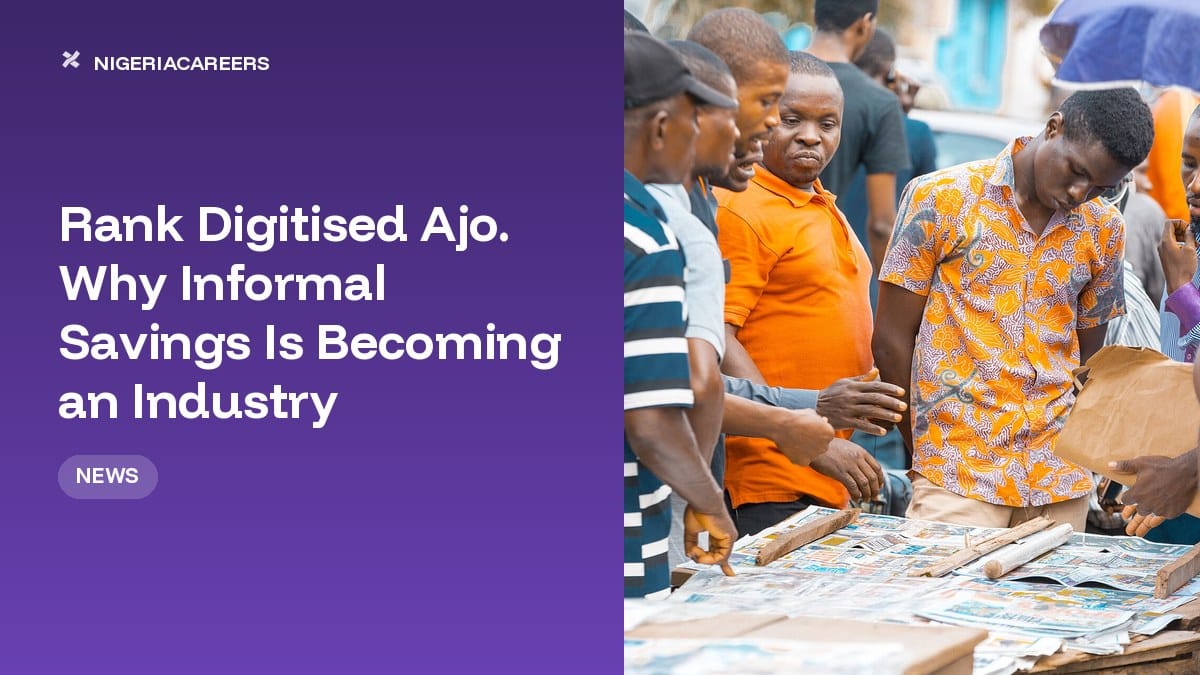
Rank, the Nigerian fintech formerly called Moni, launched three community powered products that digitise traditional savings groups, offering members access to capital at no interest through digital savings circles and trusted social networks. Acquisitions gave the company a regulated banking licence and extended it beyond credit into savings, payments and wealth management.
The products are built on a system that already exists. Ajo, esusu, adashe and their equivalents across Africa have moved money between people for generations, enforced by social relationships rather than by contracts or credit bureaus.
Why this is a large idea rather than a small one
The scale of informal savings is routinely underestimated because it does not appear in banking statistics. One frequently cited figure puts Kenya's informal savings groups, the chamas, at over 4 billion dollars in assets across more than 300,000 groups. Nigeria has no equivalently clean number and the informal sector is larger.
Thrift and credit societies work by mobilising local savings and lending to members, typically allowing a member to borrow two or three times what they have saved. That is a functioning credit system operating entirely outside formal finance, and it has lower default rates than most formal lending to the same population because the enforcement is social.
A company that can digitise that without destroying the social enforcement is building on something that works, which is rarer in fintech than it sounds.
What it means for access to capital
For a Nigerian professional or small business owner, formal credit is expensive and slow. Interest free capital through a savings circle is not charity, it is your own money returned in a lump sum at your turn, plus access to the pool when you need it. The benefit is timing, not free money.
That distinction matters when evaluating these products. A digital ajo does not create capital. It reorganises when you get access to yours, and it adds enforcement and record keeping that an informal group may lack.
The honest limitations are worth stating. Informal savings arrangements only go so far, as analysts of the sector point out. They work for amounts that members can collectively fund, over short cycles, among people who know each other. They do not fund a business expansion requiring several years of capital.
The risk that comes with digitisation
Traditional ajo depends on knowing the collector. The social sanction for defaulting is real because the people involved share a market, a church, a workplace or a street.
Digitising it introduces strangers, and the enforcement mechanism weakens exactly as the scale increases. Whether a platform can replace social pressure with something equally effective is the unanswered question in this model, and it is the thing to examine before joining a digital circle with people you do not know.
Practical questions to ask of any such product: who holds the money between contributions, what licence covers it, what happens if a member defaults mid cycle, and whether the funds are insured. Rank's regulated banking licence is relevant here, and the specific protections should be confirmed with the NDIC rather than assumed.
Where the jobs are in this
Community finance products need people who understand both the informal system and formal financial controls, and that combination is uncommon.
The functions are credit and portfolio risk adapted to group lending rather than individual scoring, field operations managing community agents, compliance and anti money laundering for a product that moves cash between many small participants, and product people who have actually participated in an ajo rather than read about one.
That last point is not a joke. The most common failure in Nigerian fintech is a product designed by people who do not use the thing they are replacing. Direct experience of informal savings is a genuine qualification for this category of work.
The broader shift
The same logic is spreading beyond savings. The African Business Angel Network was reported to have over 90 active syndicates across the continent in 2025, and commentary has argued that the thrift model maps naturally onto pooled startup investing: many people contributing modest amounts, enforced by relationships, with a more deliberate legal structure.
Treat that argument as advocacy rather than established practice. What is established is that Africans save and lend collectively at substantial scale, that formal finance has not served the same people well, and that the companies building between the two now hold banking licences.
For anyone deciding where financial services work is heading in Nigeria, that is a more reliable signal than another payments app.