Banks and Fintechs Are Now Regulated Alike. What That Means for Jobs
Lawmakers passed a bill putting OPay and Moniepoint under bank style CBN supervision, and agents must pick one principal. How the fintech war reshapes careers.

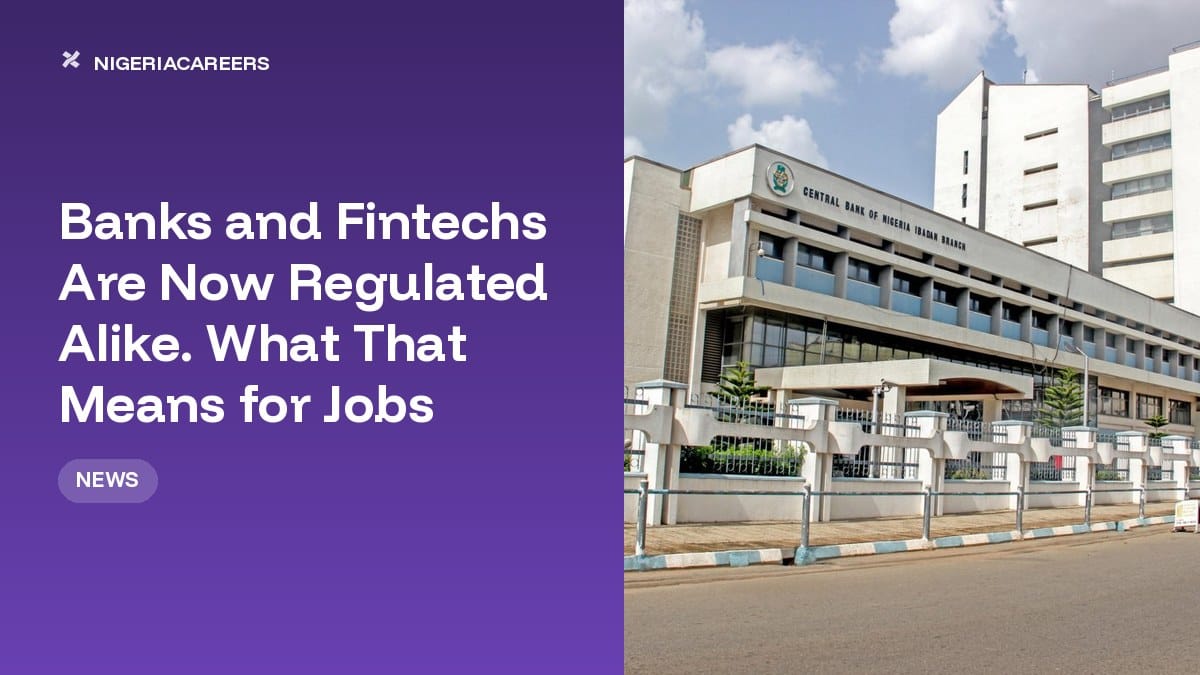
On 18 November 2026, a bill amending the Banks and Other Financial Institutions Act passed third reading in the House of Representatives, allowing the Central Bank to designate non bank players as Systemically Important Institutions. The practical effect is that the largest Nigerian fintechs would face supervision closer to what banks face.
It follows a year of tightening. In June 2026 the CBN capped how much of the payments market a single institution may control, with affected firms given until 31 December 2026 to comply. From 1 April 2026, Nigeria's banking agents were required to be exclusive to one principal, forcing roughly two million agents to choose between Moniepoint, OPay and PalmPay.
The competition has moved to the balance sheet
For several years the contest between banks and fintechs was about payments: who moved money faster and whose app failed less often. That has largely been settled in the fintechs' favour on user experience, and the ground has shifted.
The current battleground is deposits and lending. Fintechs have accumulated user bases rivalling or exceeding many tier two banks, and advertised savings rates have been aggressive, with reported promotional maximums of up to 27 percent at OPay, 20 percent at PalmPay, 17.5 percent at Moniepoint and 15 percent at Kuda. Those are headline rates with conditions attached, and the strategic point stands regardless: these companies are competing for deposits, which is what banks do.
Traditional lenders, long criticised for slow applications and unreliable transfers, have been investing heavily in their own digital channels. The gap in app quality that defined 2021 is narrower now.
What supervision does to hiring
This is the part that matters for careers, and it is predictable because it has happened in every market that regulated its fintech sector.
When a company becomes subject to bank style supervision, it has to build functions it previously ran lightly. Risk management, including credit risk, operational risk and liquidity risk. Regulatory reporting to central bank formats and deadlines. Internal audit as an independent function. Compliance, anti money laundering and sanctions screening at a scale that satisfies an examiner rather than a board. Capital adequacy calculation and management.
Those roles exist in abundance in Nigerian banking and barely at all in Nigerian fintech. The people who can do them are currently employed by banks, which means the hiring flows from banks into fintechs, usually at a premium.
If you work in risk, compliance, regulatory reporting or internal audit at a Nigerian bank and have assumed fintech is for engineers, this is the moment that assumption stops being true. Your experience is the scarce input.
What it does to engineers
Less dramatic but real. Supervised institutions need auditable systems: change management that produces a record, access controls an examiner can test, data retention that meets statutory periods, and reporting pipelines whose numbers tie back to source. Engineers who have worked in a regulated environment and understand why those constraints exist become more valuable than faster engineers who have not.
The cultural adjustment is the harder part. Shipping on Friday afternoon is a different proposition in an institution that must explain outages to a regulator.
The agent exclusivity rule is the underrated change
Requiring two million agents to pick one principal is the single largest shift in Nigeria's retail financial distribution in years. Agents who served multiple networks had to consolidate, which concentrates the market and changes the economics for everyone operating in it.
For people working in agent network management, field sales and merchant acquisition, this means fewer, larger relationships and more emphasis on retention. For anyone considering agency banking as a business, it means the choice of principal is now a long term commitment rather than a hedge.
Two cautions before you act on any of this
Licence categories reported in the press are inconsistent. Coverage variously describes the major fintechs as national microfinance banks, mobile money operators and payment service banks, and these are different licences with different permissions and different deposit insurance limits. NDIC cover differs by category, reported at up to 5 million naira per depositor in deposit money banks and mobile money operators and up to 2 million naira in microfinance banks and payment service banks, with at least one guide quoting a lower figure that conflicts with it.
Before accepting a role, or placing your own savings, confirm the licence with the CBN and the insurance limit with the NDIC rather than with a comparison blog. The difference determines what the company can legally do and what you are protected for.
The second caution is timing. A bill that has passed third reading in the House is not yet law, and implementation of designations would follow later. Hiring usually begins before the rule binds, but the direction is clearer than the schedule.
Where to position
The safest skills in this contest are the ones both sides need: credit risk, regulatory reporting, anti money laundering, and the engineering discipline to make systems auditable. Those travel between a bank and a fintech, and they hold their value whichever side wins the deposits.