CITA Energies ISO Certifications and Your Career in 2026
CITA Energies secured ISO 9001, 14001, and 45001 in March 2026. Learn what this means for Nigerian QHSE, aviation, and downstream oil and gas salaries.

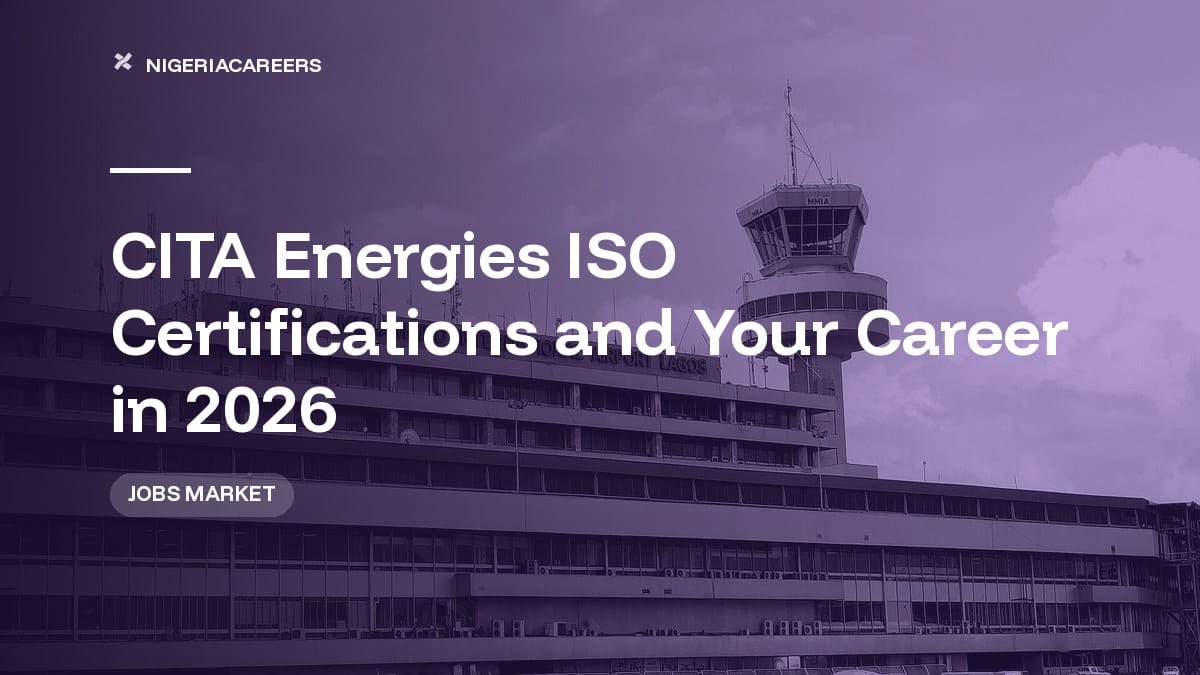
In March 2026, indigenous aviation fuel marketer CITA Energies secured three major global certifications at once: ISO 9001:2015 for Quality Management, ISO 14001:2015 for Environmental Management, and ISO 45001:2018 for Occupational Health and Safety.
Showcased at the NIGAV Centre at Murtala Muhammed International Airport in Ikeja, Lagos, this milestone puts the 20-year-old firm in the same compliance bracket as multinationals like TotalEnergies. For Nigerian job seekers in engineering, logistics, and safety, this signals a fundamental shift in how indigenous energy companies hire and pay.
When an operator managing over 240 million litres of jet fuel throughput annually across 17 Nigerian airports upgrades to triple ISO compliance, paper qualifications alone stop working. Operational discipline, audit readiness, and certified systems knowledge become the primary hiring filters.
Why CITA Energies' Triple Crown Matters to Job Seekers
CITA Energies is not a small downstream player. Led by Chairman Dr. Thomas Ogungbangbe, the company is valued near $200 million as of October 2026 and controls access to over 20 million litres of storage capacity across one marine terminal and 17 airfields across Nigeria's six geopolitical zones. It also holds a major stake in the Joint Users Hydrant Installation 2 (JUHI-2) alongside marketers like Masters Energy, Techno Oil, and Ascon.
Before March 2026, many mid-sized indigenous oil and gas marketers treated international standards as optional paperwork. You could get hired as a depot supervisor, lab technician, or safety officer based on basic field familiarity and a generic degree.
That era is closing. Speaking at the certification showcase in Lagos, CITA Energies Chief Operating Officer Titilayo Olaore explained that earning these three certificates required months of sleepless nights, internal reforms, document verification, and rigorous cross-checking by internal ISO champions and external auditors.
To keep those certificates, an ISO-certified company must pass annual surveillance audits and full recertification audits every three years. If staff fail to log fuel quality tests properly, skip a safety permit, or mishandle chemical runoff at an airport depot, the company risks losing its certification. Losing an ISO badge can immediately disqualify an aviation fuel supplier from servicing international airlines.
Because the stakes are this high, CITA Energies and competing marketers like MRS Oil Nigeria, Conoil, and Sahara Group's Asharami Synergy cannot afford to hire untrained personnel. They now actively poach professionals who already understand ISO clauses, Corrective and Preventive Actions (CAPA), and digital traceability.
What Each ISO Standard Demands From Employees
In technical interviews at CITA Energies or any top-tier downstream energy firm, recruiters test your practical grasp of these three standards. Knowing the numbers is not enough. You must understand how each standard changes daily work on the ground.
ISO 9001:2015 (Quality Management System)
In aviation fuelling, quality failure is catastrophic. As Dr. Ogungbangbe noted during the company's 20th anniversary in October 2026, the Jet-A1 fuel lifted into a plane in Lagos must meet the exact chemical parameters of fuel lifted in Atlanta.
ISO 9001 governs consistency, traceability, and defect prevention. As a Quality Assurance or Quality Control (QA/QC) officer, chemist, or into-plane fuelling operator, this standard requires you to document every batch test from the refinery or marine terminal down to the aircraft wing. Dr. Ogungbangbe has publicly advocated for digital platforms linking local suppliers like the Dangote Refinery, depot operators, the Nigerian Civil Aviation Authority (NCAA), and airlines to eliminate manual paperwork gaps. Professionals who can manage digital quality logs and Joint Inspection Group (JIG) standards are the top priority for hiring managers.
ISO 14001:2015 (Environmental Management System)
Storing millions of litres of aviation turbine kerosene (ATK) in Lagos, Abuja, Port Harcourt, Calabar, and Owerri carries massive environmental liability. ISO 14001 forces a company to track, reduce, and control its environmental footprint.
For environmental officers and depot managers, this means strict compliance with effluent discharge rules, spill containment protocols, waste disposal logs, and carbon footprint tracking. Hiring managers look for candidates who have handled statutory audits for the National Environmental Standards and Regulations Enforcement Agency (NESREA) or the Nigerian Midstream and Downstream Petroleum Regulatory Authority (NMDPRA) alongside ISO 14001 frameworks.
ISO 45001:2018 (Occupational Health and Safety)
Operating 15 aircraft refueller bowsers and managing dozens of contracted bulk road vehicles (BRVs) across busy airport aprons and Nigerian highways is a high-risk operation. ISO 45001 replaces older safety frameworks with a proactive system focused on hazard identification, risk assessment, and leadership accountability.
For Health, Safety, and Environment (HSE) officers, fleet supervisors, and maintenance engineers, ISO 45001 means enforcing Permit-to-Work (PTW) systems, conducting Job Hazard Analyses (JHA), and running documented incident investigations. You are no longer just handing out hard hats and safety boots. You are auditing human behaviour and mechanical reliability to prevent accidents before a truck even leaves the depot.
The 5 Roles Seeing the Biggest Hiring Demand
Whenever a major Nigerian energy firm integrates ISO 9001, 14001, and 45001 into an Integrated Management System (IMS), five specific job families see immediate hiring and retention pressure.
- QHSE / IMS Coordinators and Auditors: Companies need specialists who can manage all three standards simultaneously rather than hiring separate quality, safety, and environmental leads. Your job is to run internal mock audits, close out non-conformities, and prepare depot teams for external assessors.
- Aviation Fuel Quality Control Chemists and Technicians: Operating under ISO 9001 and international aviation fuel quality procedures (IFQP) requires laboratory staff who understand calibration traceability, sampling integrity, and contamination testing at airport tank farms.
- Internal Control and Compliance Officers: As CITA Energies COO Titilayo Olaore highlighted, embedding standards into company culture requires constant follow-ups and cross-checking. Compliance officers bridge the gap between finance, inventory loss prevention, and operational SOPs.
- Into-Plane Operations and Depot Supervisors: Engineers who manage fuel hydrant systems, bowser leasing, and bulk storage facilities must ensure their daily shift logs align with ISO 45001 and 9001 clauses.
- Fleet and Logistics Safety Supervisors: With CITA coordinating its own fleet plus contracted haulage trucks moving Jet-A1 across 17 airports, logistics managers who can enforce ISO-compliant driver safety, journey management, and vehicle epicote certification are indispensable.
What ISO and QHSE Skills Pay in Nigeria (2025/2026 Benchmarks)
Adding recognized ISO auditing credentials and safety certifications to a technical degree directly increases your market value in Nigeria's energy, manufacturing, and construction sectors. Based on 2025 and 2026 industry compensation data across Lagos, Port Harcourt, and Abuja, verified pay brackets break down across experience levels:
- Entry-Level HSE / QA Officer: ₦280,000 to ₦350,000 net per month. This applies to professionals with 1 to 3 years of site or depot experience, an HSE Level 1 to 3 certificate, and basic ISO awareness training.
- Mid-Level QHSE / ESG Supervisor: ₦400,000 to ₦500,000 net per month (roughly ₦4.8 million to ₦6 million annually) at mid-sized industrial and agribusiness firms, rising to ₦7 million to ₦9 million gross annually in downstream oil and gas or construction. Employers require 4 to 6 years of experience, NEBOSH IGC, and at least one ISO Lead Auditor certificate.
- Environmental Manager (ISO 14001 Specialist): ₦6 million to ₦14 million gross annually (₦500,000 to ₦1.16 million per month). Demand is highest among Lagos manufacturing plants, tank farms, and energy companies facing strict environmental audits.
- Senior QHSE Manager / Compliance Lead: ₦8 million to ₦18 million gross annually (₦660,000 to ₦1.5 million per month) at top indigenous operators and multinationals like Dangote Group, Julius Berger, TotalEnergies, and Chevron. Offshore and specialized process safety consultants command daily contract rates exceeding $500.
Furthermore, building a track record at an ISO-certified Nigerian company unlocks international mobility. According to 2025 placement data from Nigerian safety consultancies, local QHSE professionals with practical ISO 45001 implementation experience and NEBOSH certifications regularly secure regional West African roles paying $45,000 to $85,000 annually, or relocate to Qatar, Saudi Arabia, and the UAE for packages between $65,000 and $130,000 per year.
How to Position Yourself for Jobs at ISO-Certified Energy Firms
If you want to work at CITA Energies, MRS, TotalEnergies, or major aviation handling companies like NAHCO and SAHCO, do not just send a generic CV listing your university degree. Follow these concrete steps to make yourself hireable for compliance-driven roles.
1. Get an Accredited ISO Lead Auditor Certificate
Skip unaccredited ₦15,000 weekend certificates that employers throw in the bin. Enrol in a 5-day (40-hour) Lead Auditor course certified by CQI/IRCA (Chartered Quality Institute / International Register of Certificated Auditors) or PECB.
In Nigeria, you can take ISO 9001, 14001, or 45001 Lead Auditor courses through accredited providers like SGS Nigeria, Novelle Center (a BSI Associate Consultant), Ciel Consulting, or AVIMETA Consultants. Depending on the provider and whether you book early-bird online slots or classroom sessions, local training and exam fees in 2026 range from ₦200,000 to ₦450,000. If you work in downstream petroleum or aviation, start with ISO 9001 or ISO 45001.
2. Pair ISO With Statutory and Technical Credentials
An ISO certificate proves you understand management systems, but Nigerian energy employers want core safety competence alongside it. According to Lagos recruitment data, roughly 78% of senior HSE roles require NEBOSH (National Examination Board in Occupational Safety and Health) certification. Registering with the Institute of Safety Professionals of Nigeria (ISPON) also gives you statutory credibility when dealing with local government inspectors.
3. Rewrite Your CV Using Audit Metrics
Stop writing vague bullet points like "Responsible for safety and quality at the depot." ISO-certified companies hire people who measure outcomes. Rewrite your experience using the exact language of ISO clauses:
- Weak: "Ensured fuel trucks were safe and followed company rules."
- Strong: "Conducted weekly ISO 45001 compliance audits across 25 bulk road vehicles, closing 14 non-conformities and achieving zero lost-time injuries (LTI) over 18 months."
- Weak: "Helped the company prepare for quality inspections."
- Strong: "Served as departmental ISO 9001 champion, digitizing batch traceability logs and cutting audit document retrieval time by 40% during external surveillance audits."
4. Target the Right Operational Hubs
CITA Energies runs its headquarters out of the JUHI-2 concourse at Murtala Muhammed International Airport (MMIA), Ikeja, Lagos, and operates key depot and into-plane facilities in Abuja, Port Harcourt, Calabar, Kano, and Owerri. When applying directly through their corporate portal or networking with aviation fuel heads on LinkedIn, specify your willingness to work shifts at airfield depots where 24/7 operations actually happen.
Frequently Asked Questions
Which ISO certification should a Nigerian engineering or science graduate take first?
If your background is in chemical engineering, industrial chemistry, or laboratory technology, start with ISO 9001 (Quality Management System) or ISO/IEC 17025 (Testing and Calibration Laboratories). These apply directly to fuel testing, manufacturing QA/QC, and metering. If you want to work in field operations, construction, or depot management, take ISO 45001 (Occupational Health and Safety) first, as safety roles have the highest volume of job openings across Nigeria.
Can I get a QHSE job at CITA Energies or another oil marketer with just an ISO certificate and no experience?
An ISO Lead Auditor certificate alone will not get you a mid-level supervisory job without field hours. However, for NYSC members and fresh graduates, combining an ISO Internal or Lead Auditor course with HSE Level 1 to 3 gives you a massive advantage for graduate trainee programs, tank farm internships, and entry-level quality control technician roles paying ₦200,000 to ₦300,000 monthly. Once inside, volunteer to become a departmental "ISO Champion" during audit seasons to fast-track your promotion.
How do Nigerian employers verify if my ISO certificate is genuine?
HR departments and compliance managers at ISO-certified firms verify your credentials directly on the online registers of global accrediting bodies like CQI/IRCA, PECB, or Exemplar Global using your unique certificate identification number. Always confirm that your Nigerian training institute is an approved training partner (ATP) of an international body before paying tuition.