Nigeria's Aviation Hub Push and What It Means for Your Career
Nigeria is building MRO hubs and handing airports to private operators. See which aviation roles are hiring, real 2026 salaries, and how to get licensed.

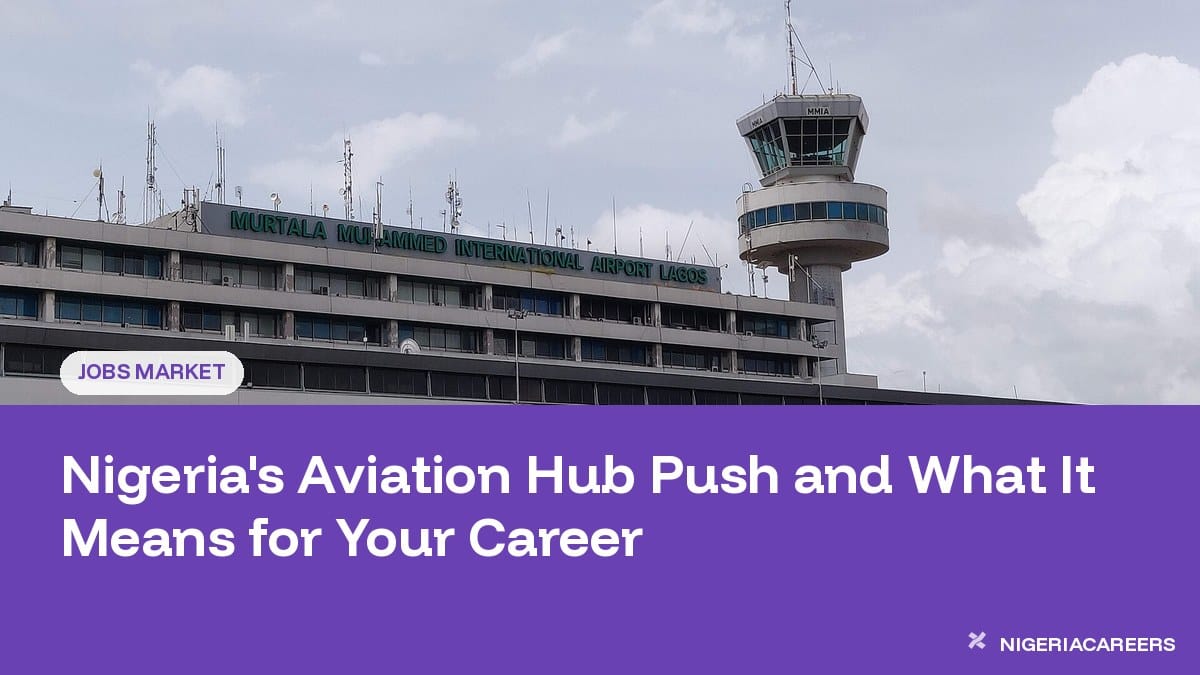
Nigerian airlines spend up to $2.5 billion every year flying their planes abroad for routine maintenance, according to the Federal Airports Authority of Nigeria (FAAN). That capital flight is now reversing, creating the biggest wave of technical and commercial aviation hiring in Nigeria in two decades.
Between Air Peace building a 34,000-square-metre Maintenance, Repair, and Overhaul (MRO) facility in Lagos, Ibom Air launching international flights and operating a new MRO hub in Uyo, and the federal government handing major airports to private concessionaires, the job market is shifting fast.
Yet the sector faces a stubborn paradox. Over 300 young Nigerian pilots with basic commercial licences are sitting at home unemployed, while airlines desperately hunt for type-rated captains, licensed aircraft engineers, and air traffic controllers. Knowing where the actual bottlenecks are is the difference between paying millions for a useless certificate and walking straight into a high-paying role.
Why the Aviation Hub Push Is Changing the Job Market
For decades, Nigerian aviation operated as a spoke rather than a hub. Planes flew in, dropped passengers, and flew out to Addis Ababa, Cairo, or Johannesburg for maintenance and transit connections. Three major infrastructure shifts between 2025 and late 2026 are changing that structure on the ground.
First is domestic aircraft maintenance. In September 2025, Air Peace broke ground on a N32 billion MRO complex at Murtala Muhammed International Airport in Lagos, backed by a technical partnership with Brazilian aircraft manufacturer Embraer. The facility includes a 6,200-square-metre hangar built to service a wide-body Boeing 777 and five smaller jets simultaneously. Air Peace alone previously spent N180 billion annually on overseas maintenance. Keeping that work in Lagos, alongside third-party contracts for other West and Central African carriers, moves thousands of engineering, supply chain, and tooling jobs onshore.
Second is the rise of Uyo as a sub-national transit and maintenance hub. Following the federal government's upgrade of Victor Attah International Airport to full international status in late 2025, Ibom Air moved operations to a new international terminal in June 2026 alongside a state-backed MRO facility. To staff this expansion, Ibom Air sponsored 35 indigenous cadets (15 pilots and 20 aircraft maintenance engineers) through the Airbus Flight Academy in Toulouse, France, and the Ethiopian Airlines Aviation Academy, graduating the cohort in late 2025.
Third is private airport management. Under Minister of Aviation and Aerospace Development Festus Keyamo, the federal government has accelerated public-private partnerships to stop running secondary airports at a loss. In January 2026, the government signed a concession agreement transferring Akanu Ibiam International Airport in Enugu to Aero Alliance Limited. In November 2026, it signed a 30-year concession deal for Port Harcourt International Airport with Port Harcourt Airport Company Limited.
In addition, the October 2026 settlement of the 20-year legal dispute between FAAN and Bi-Courtney Aviation Services cleared MMA2 in Lagos to expand its apron and begin handling regional African flights. While union agreements protect existing FAAN workers from layoffs during concessions, private operators are actively hiring commercial talent to grow non-aeronautical revenue, including retail management, cargo logistics, and terminal operations.
The Roles Most in Demand Right Now
Do not look at aviation as just pilots and cabin crew. The sharpest shortages are in technical licensing, airspace management, and airline revenue operations.
- Licensed Aircraft Maintenance Engineers (AMEs): With MRO hangars going up in Lagos and Uyo, engineers who hold a Nigerian Civil Aviation Authority (NCAA) licence with ratings in Airframe and Powerplant (A&P) or Avionics are the most sought-after workers in the sector. Engineers with specific type ratings on Embraer E-Jets (E170/190/195-E2), Airbus A220s, or Boeing 737s can name their price.
- Air Traffic Controllers (ATCs): Nigeria faces a severe controller crunch. According to the National Air Traffic Controllers Association (NATCA), the Nigerian Airspace Management Agency (NAMA) risks losing over 70 experienced controllers to retirement within a few years, forcing the agency to recall retired personnel on contract just to keep control towers staffed. Although more than 100 student controllers were in training at the Nigerian College of Aviation Technology (NCAT) in Zaria as of late 2026, it takes a minimum of three years to train a controller to full operational proficiency.
- Type-Rated Captains and First Officers: Notice the word "type-rated". Nigeria has plenty of fresh graduates with a 250-hour Commercial Pilot Licence (CPL). What airlines actually need are captains with 5,000 total flight hours (including 500 to 1,000 Pilot-in-Command hours on jets) and First Officers with at least 900 hours and a current type rating on commercial fleets like the CRJ-900, Embraer E195-E2, or Boeing 777.
- Flight Dispatchers and Operations Control Staff: Every commercial flight requires a licensed dispatcher to calculate fuel loads, interpret weather patterns, and file flight plans. Because airlines are adding regional and intercontinental routes (such as Air Peace's Abuja-London Heathrow and Lagos-Gatwick operations, plus planned Brazil routes), 24/7 Operations Control Centres are constantly recruiting young graduates with an NCAA Flight Dispatcher licence.
- Commercial and Customer Experience Specialists: As domestic carriers expand internationally and private concessionaires take over terminals, hiring for commercial roles has surged. In late 2026, Air Peace was actively recruiting senior commercial talent in Lagos, including specialists in Revenue Management and Pricing, Network Planning and Scheduling, and Customer Experience Management.
What Aviation Jobs Pay in Nigeria (2025/2026 Benchmarks)
Aviation pay in Nigeria is split into two worlds: dollar-benchmarked packages for scarce technical flight crew, and tiered naira salaries for ground, regulatory, and entry-level roles. The following figures reflect verified 2025 and 2026 industry payroll benchmarks and recruitment offers across Nigerian carriers:
- Jet Captains: N3,000,000 to N5,000,000 per month on standard domestic naira payrolls. However, on international or commuting contract terms, pay is much higher. An August 2026 recruitment drive for Air Peace Embraer E190/E195 captains offered $9,000 per month net (roughly N14 million), alongside housing, ground transport, and an 8-weeks-on, 3-weeks-off rotation.
- First Officers: N1,500,000 to N2,500,000 per month for type-rated officers on domestic fleets. Entry-level first officers building initial jet hours earn between N500,000 and N1,200,000 monthly, while experienced international contract First Officers on the E190/E195 fleet command up to $7,000 monthly net.
- Licensed Aircraft Engineers: N1,000,000 to N1,800,000 per month in basic and allowance pay. Senior engineers holding multiple international authorisations (such as FAA or EASA licences alongside their NCAA licence) earn N2,000,000 or more per month.
- Customer Experience and Commercial Managers: N600,000 to N800,000 per month at entry-to-mid level, rising to N900,000 to N1,100,000 for mid-level managers. Senior Customer Experience Officers and commercial heads at top carriers earn N1,200,000 to N1,600,000 per month.
- Air Traffic Controllers: N600,000 to N900,000 per month for entry-level controllers, rising to N1,200,000 to N1,600,000 per month for senior radar and area controllers.
- Cabin Crew: N400,000 to N700,000 per month for junior flight attendants (combining basic salary and hourly flight allowances), while senior cabin crew and pursers earn N800,000 to N1,200,000 per month.
- Assistant Flight Dispatchers (Graduate Trainees): N235,000 to N340,000 per month (averaging N287,500 monthly) during initial trainee deployment at major carriers like Air Peace, before moving onto full dispatcher scales after confirmation.
Public-sector aviation agencies also remain popular employers. While NCAT Zaria Rector Dr. Danjuma Ismaila publicly noted in 2025 that the college had the lowest pay among federal aviation agencies and was losing instructors to private airlines, NCAT introduced paid study leave and began implementing a revised salary structure in July 2026 to match sister agencies like the NCAA, NAMA, and FAAN.
The Training Bottleneck: Costs and Reality at NCAT Zaria
Before you quit your job or ask your family to sell land for aviation school, look closely at the numbers. Aviation training is capital-intensive, and Nigeria's primary public training institution, NCAT Zaria, has strict capacity limits.
In July 2026, NCAT Rector Dr. Danjuma Ismaila disclosed that the college admits only about 25 pilot trainees every six months because of limited serviceable training aircraft and maintenance funding constraints. Even if you secure a slot, the fees are steep. According to NCAT's 2025/2026 course fee schedules, the two-year Standard Pilot Course costs N23,225,200 (inclusive of accommodation and feeding), while the abridged Commercial Pilot Licence course costs N12,000,000.
Worse, graduating with a basic Commercial Pilot Licence and 250 flight hours does not make you immediately employable to an airline flying 130-seat jets. Insurance requirements and operational safety rules prevent airlines from putting low-hour rookies into commercial jet cockpits without expensive type-rating and line training.
If you do not have N23 million or a guaranteed sponsor, look at the technical and operational tracks at NCAT or NCAA-approved private schools instead:
- Aircraft Maintenance Engineering (HND / Licence Track): The two-year HND in Aircraft Maintenance Engineering (Airframe and Powerplant or Avionics) at NCAT costs roughly N816,775 in base tuition (excluding accommodation and feeding, which runs about N38,500 per week for meals plus hostel rates). If you already hold a BSc or HND in Mechanical or Electrical Engineering, you can take the Abridged Airframe and Powerplant or Avionics course to qualify for your NCAA licence exams faster.
- Standard Flight Operations (Flight Dispatch): The 15-week Standard Flight Operations course at NCAT costs roughly N574,050 to N647,300 depending on accommodation options. It is the fastest, highest-ROI technical entry point into an airline operations room.
- Cabin Crew Initial Training: Takes 6 to 12 weeks at NCAA-approved private aviation training organisations in Lagos or Abuja (or NCAT), costing between N350,000 and N500,000 plus NCAA examination and medical fees.
Four Practical Ways to Break Into the Sector Today
If you want to build a career out of Nigeria's aviation hub expansion without getting stuck in the unemployed pilot backlog, take one of these four routes.
- Use the Flight Dispatch Graduate Trainee Backdoor: If you already have a BSc or HND in any science, engineering, geography, or numerate field and have completed NYSC, pay for a 15-week NCAA-approved Flight Dispatcher course. Pass your NCAA dispatcher licence exam, then apply directly for Assistant Flight Dispatcher Graduate Trainee openings (such as the Air Peace trainee programme, which accepts candidates with 0 to 2 years of experience and pays up to N340,000 monthly to start). Once inside an airline's Operations Control Centre, you can transition into network planning, crew scheduling, or safety management.
- Convert Your Engineering Degree into an AME Licence: With Air Peace's Lagos MRO and Uyo's MRO needing hundreds of technicians over the next 24 months, mechanical, electrical, and aerospace engineering graduates have a massive advantage. Apply for the abridged engineering courses at NCAT Zaria (entrance exams typically hold in September each year) or join an airline cadet engineering scheme.
- Target State Government Sponsorships and Airline Cadetships: Do not self-fund a pilot licence unless your family can comfortably afford both the CPL and a subsequent jet type-rating. Instead, watch for state-backed cadet programmes. NCAA Director-General Captain Chris Najomo has actively urged aspiring pilots and engineers to seek state government sponsorship, following the Akwa Ibom State model that fully funded 35 cadets for Ibom Air in Toulouse and Addis Ababa.
- Pitch Your Commercial Skills to Airlines and Airport Concessionaires: You do not need an NCAA licence to earn N1.2 million a month in aviation. If you have strong experience in data analytics, pricing, B2B sales, logistics, or customer relations from banking, telecoms, or FMCG, target the commercial departments of expanding carriers and the private operators taking over Enugu (Aero Alliance) and Port Harcourt (Port Harcourt Airport Company Limited) airports.
Frequently Asked Questions
Can I get an aviation job in Nigeria with a regular university degree and no technical licence?
Yes. Airlines and private airport concessionaires hire regular BSc and HND graduates for cabin crew, customer service, revenue management, route scheduling, procurement, HR, and finance. For example, Ibom Air's standard cabin crew recruitment requires a university degree or HND (minimum 2:2 or Upper Credit), an NYSC discharge or exemption certificate, and a maximum age of 28 at entry, after which the airline puts selected candidates through initial safety training.
Why are there over 300 unemployed pilots in Nigeria if airlines are expanding?
Most unemployed Nigerian pilots only hold a basic Commercial Pilot Licence with around 250 flight hours on single-engine or light twin training planes. Commercial airlines operating passenger jets require a specific aircraft type rating (which costs tens of thousands of dollars extra) plus 500 to 1,000+ flight hours. Without a thriving general aviation sector (light charter planes, agricultural aviation, and private pistons) where young pilots can build hours cheaply, fresh graduates get stuck in the gap between flight school and airline minimum requirements.
Which pays better for a young Nigerian graduate: becoming a pilot or an aircraft maintenance engineer?
Captains earn more at the peak of their careers, taking home N3 million to N5 million+ monthly (or $9,000 on international contracts) compared to N1 million to N2 million+ for licensed engineers. However, aircraft maintenance engineering offers a much safer return on investment right now. Training as an engineer at NCAT costs a fraction of the N23.2 million pilot fee, job placement is much faster due to the new MRO facilities in Lagos and Uyo, and you do not face the multi-year flight-hour bottleneck that leaves rookie pilots stranded.