Your Old Phone Number Can Still Reach Your Bank Account
Recycled Nigerian SIMs are delivering bank alerts and OTPs to strangers. What NCC's TIRMS does, what it does not do, and how to protect your accounts.

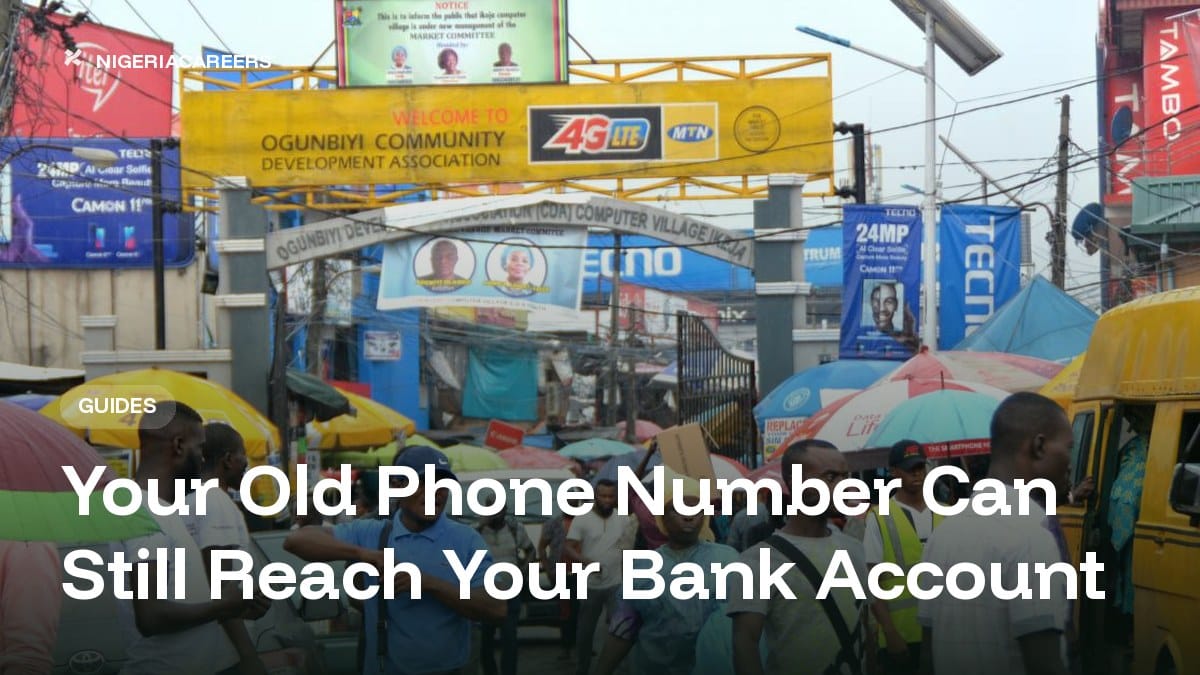
A Nigerian phone number that goes unused long enough is reclaimed by the operator and sold to someone else. That is normal practice worldwide. What makes it dangerous in Nigeria is that the number is frequently still attached to a bank account, and the new owner starts receiving the alerts and one time passwords that belong to the previous one.
Reported cases describe exactly that: transaction alerts arriving for strangers, and in some accounts funds being taken from accounts the bank could not recover. A consumer foundation has documented losses through USSD and recycled numbers. There is no public registry of recycled numbers that banks can routinely consult.
Why this is a professional problem, not just a consumer one
Most Nigerian professionals accumulate numbers. A line for work, a line for a previous employer's device, a line kept for a bank account opened years ago, a line bought for better data coverage in one state. Lines go dormant without anybody deciding to abandon them.
The exposure is wider than a bank account. A recycled number can be the recovery route for an email account, which in turn is the recovery route for everything else. It can be the two factor authentication method for a work system, a cloud account, a crypto exchange or a domain registrar. For anyone who freelances, contracts or runs anything of their own, a reclaimed number is a credential handed to a stranger.
The regulator's response
The Nigerian Communications Commission has built the Telecommunications Identity Risk Management System, intended to let authorised organisations check whether a number has been swapped or reassigned. Reporting scheduled it to go live in October 2026, with later coverage describing it being extended to additional sectors.
Its scope is narrow by design. TIRMS does not let anyone look up a person's identity or bank accounts from a phone number, and proposals to automatically detach recycled lines from legacy bank accounts have appeared in commentary rather than in confirmed rules.
Sources also differ on the waiting period before a number can be reassigned, with references to business rules set in 2024, a further period of inactivity, and a call by the House of Representatives in April 2026 for the NCC to consider extending the period from twelve to eighteen months. The current rule should be confirmed with the NCC rather than taken from news coverage.
The honest summary is that a real fix is being built, it is partial, and it places the burden of checking on institutions rather than removing the underlying risk.
What to do this week
List every Nigerian number you have ever used. Include the ones from a previous employer and the one you stopped topping up in 2019.
For each number still in your possession, keep it alive. A small recharge and an outgoing call or data session at intervals is enough to reset the inactivity clock, and it is far cheaper than losing the line.
For each number you no longer control, go through the accounts it might still be attached to and change the registered number. Banks, mobile money apps, email, the national identity portal, tax and pension portals, any exchange, and any service where you set up two factor authentication by SMS.
Move away from SMS as an authentication method wherever an alternative exists. An authenticator application on your phone does not depend on a telephone number remaining yours, which removes the entire class of risk.
If you start receiving bank alerts meant for someone else, write to the bank and ask for the old number to be removed from the account. Do it in writing, keep the reference, and escalate to the NCC if it is not acted on. Using someone else's account because the alerts reached your phone is theft, and the fact that the number was sold to you legitimately is not a defence.
If you work in financial services or operations
This is a control gap with a clear owner. The question for any institution holding customer phone numbers is how it learns that a number has changed hands. Until recently the answer was that it did not learn, and TIRMS exists so it can.
Anyone in operations, risk or compliance at a Nigerian bank, fintech or insurer who can write the process for periodic reassignment checking against TIRMS is solving a problem the institution has and has probably not assigned. That is a visible piece of work and the kind that gets noticed, because the alternative is discovering the gap through a customer loss.
The underlying point
Nigerian digital identity is built on the phone number. Bank verification, account recovery, government portals and most authentication run through it, and the number is the one component in that stack that can be taken away and given to somebody else by a commercial process you are not party to.
Until that changes, the reasonable defence is personal: know which numbers you hold, keep the ones that matter active, and stop using a telephone line as the key to anything you cannot afford to lose.