Uber's $293M Africa Bet and Exit From Nigeria Explained
Uber pledged $293M to South Africa before exiting Nigeria and cutting 3,300 jobs. See where mobility tech roles, salaries, and driver profits are moving.

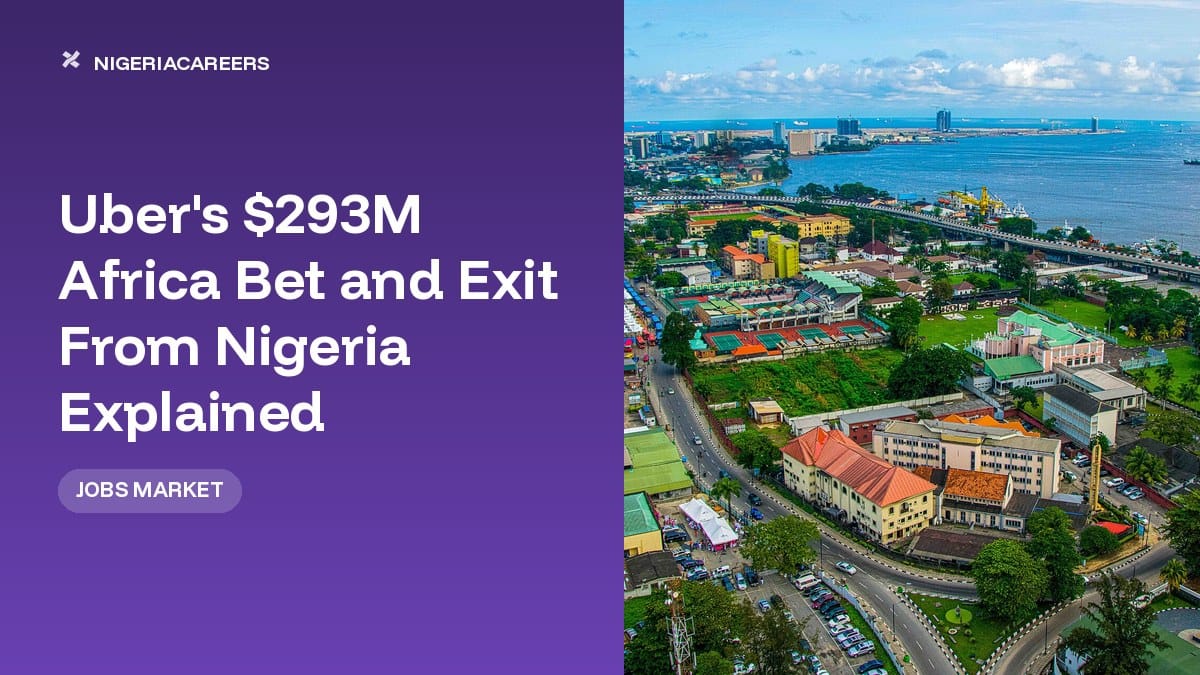
In April 2026, Uber pledged R5 billion ($293 million) to scale its South African operations, only to shut down its 12-year-old Nigerian business five months later on September 2, 2026. For Nigerian tech professionals, operations managers, and gig workers, this split strategy is the clearest signal yet of where global mobility money is moving.
Uber is not abandoning Africa. It is concentrating capital into high-margin electric vehicle (EV) hubs, food delivery, and autonomous logistics while cutting loose volatile, cash-heavy commuting markets.
If you work in Nigerian mobility, logistics, or ride-hailing, your career playbook just changed. Here is where the $293 million is actually going, why Nigeria lost out, and how to position yourself for the companies filling the vacuum.
Where Uber's $293 Million Africa Investment Is Actually Going
When news broke of Uber's $293 million (R5 billion) commitment in April 2026, many African tech workers assumed a continent-wide hiring spree was coming. The reality was strictly targeted. Every dollar of that capital injection was ring-fenced for South Africa.
Uber earmarked the funds for four specific growth areas:
- Electric Vehicle (EV) Fleet Expansion: Scaling South Africa's tiny baseline fleet of roughly 70 EVs into a commercial network.
- Charging Infrastructure: Funding physical charging depots to support the rollout of Uber Go Electric into South African townships.
- Uber Eats Hardware: Buying merchant tablets, point-of-sale hardware, and logistics tech to capture retail and grocery delivery.
- Driver Incentives: Running targeted onboarding campaigns to keep drivers on the platform amid fierce competition from Bolt and local rival Wanatu.
Even in South Africa, Uber's investment came with friction. A September 2025 South African transport law required all e-hailing cars to carry physical company branding, install passenger panic buttons, and geotag drivers. While Bolt and Wanatu met the March 11, 2026 licensing deadline, Uber missed it and had to use its $293 million pledge partly as economic leverage while lobbying for regulatory relief.
The takeaway for corporate tech professionals is simple. Global platforms are no longer spending venture money to subsidise cheap taxi rides across 20 African capitals. They are spending capital expenditure on physical assets, EV infrastructure, and automated delivery in markets where consumers pay via credit card and unit economics hold up in dollars.
Why Uber and Moove Pulled Out of Nigeria
While South Africa got $293 million, Nigeria got an exit email. On September 2, 2026, Uber shut down operations in Nigeria and Uganda on the exact same day it announced 3,300 global corporate layoffs, cutting roughly 10% of its 34,000-person workforce. Those cuts followed earlier withdrawals from Tanzania and Côte d'Ivoire.
Nigeria's ride-hailing market was valued at roughly $301 million in 2025 according to Ken Research, with local estimates putting the broader e-hailing ecosystem near $450 million. Despite more than 20,000 registered ride-hailing drivers in Lagos alone, volume did not translate into dollar profits for San Francisco.
Three financial pressures broke Uber's Nigerian model:
- The Three-Way Margin Squeeze: Petrol price hikes, naira depreciation, and soaring spare-part costs crushed driver take-home pay. Drivers demanded higher fares, cash-strapped riders refused to pay them, and Uber pushed its commission cut up toward 30% on lower base fares before walking away.
- Cash Rigidities: Uber resisted Nigeria's cash-heavy and peer-to-peer transfer culture for years, while rivals adapted with flexible fare bidding.
- The Global Pivot to Autonomous Tech: CEO Dara Khosrowshahi restructured Uber to strip out middle management (cutting staff seven or more layers below the CEO by 20%) and funnel cash into AI, robotaxis, and automated delivery.
One month later, the dominoes hit Nigeria's flagship mobility unicorn. On October 8, 2026, Moove, the Lagos-founded vehicle financing company that Uber backed in a $100 million Series B round in March 2024, announced it was also ending Nigerian operations.
Moove started in Lagos in 2020 with 76 cars, grew to serve over 9,000 Nigerian drivers, and generated ₦57 billion in customer revenue domestically. Yet by August 2026, Moove had raised $250 million in a Series C round led by Mubadala at a $2.1 billion valuation to do something completely different: manage autonomous robotaxi fleets and build robotic charging depots (called "Nests") for Alphabet's Waymo in Phoenix and Miami.
Upon exiting Nigeria in October 2026, Moove transferred roughly ₦35 billion worth of vehicles to its eligible Nigerian drivers debt-free. The message was unmistakable. Both Uber and Moove decided that managing low-margin human fleets in naira could not compete with managing autonomous fleets in dollars.
Where the Corporate Tech and Operations Jobs Are Now
If you are an operations manager, fleet specialist, software engineer, or growth marketer who targeted Uber or Moove as a career destination, you need to redirect your job search immediately. Uber reduced fully remote roles to roughly 1% of its global headcount during its September 2026 restructuring, meaning remote US roles from Lagos are essentially closed.
Instead, hiring and capital in African mobility have shifted to three specific pockets.
1. Autonomous and Drone Logistics (Zipline)
While Uber cut passenger transport in Nigeria, it participated in autonomous drone company Zipline's $1.5 billion funding round in November 2026 (valuing Zipline at $21.5 billion). Backed by a $150 million pay-for-performance award from the US State Department, Zipline is rolling out at least 20 new distribution centres across Africa over two years, targeting 15,000 health facilities across Nigeria, Ghana, Kenya, Côte d'Ivoire, and Rwanda.
In November 2026, Zipline hired 13-year Uber veteran Anthony le Roux as Head of Operations for Africa (effective January 2027) to lead this buildout. The expansion is projected to create over 800 skilled jobs across the continent.
Actionable move: Target Zipline's Nigerian and West African openings in airspace regulatory affairs, off-grid power engineering, flight operations, and cold-chain logistics.
2. Shared Corporate Commuting and Surviving Apps (Bolt, Shuttlers, LagRide)
Within two weeks of Uber's exit, Bolt recorded a 92% surge in Nigerian driver registrations and reaffirmed its commitment to its 33 Nigerian cities. Meanwhile, corporate bus-sharing platform Shuttlers launched its "Shuttlers Pod" service in Lagos in September 2026, and companies like Treepz and state-backed LagRide continue to expand managed fleets.
Actionable move: Look for B2B enterprise sales, regulatory policy, and fleet operations roles at Bolt, Shuttlers, and inDrive. Because driver unions are aggressively fighting commission rates, platforms are actively hiring government relations and partner-operations leads to keep supply stable.
3. Global Autonomous Fleet Operations (Relocation or Regional Hubs)
Moove moved its headquarters to the UAE and announced plans in August 2026 to grow its autonomous vehicle division staff by more than 220%, expanding from 150 employees to roughly 500 by the end of 2026. Those roles are concentrated in Dubai, the US, the UK, and Europe.
Actionable move: If you have fintech credit-scoring, telematics, or fleet depot management experience from Nigeria, position your CV around "asset utilization" and "charging infrastructure operations" to apply for Moove's UAE or European hubs.
2026 Salary Benchmarks for Mobility and Operations Professionals in Nigeria
If you are negotiating an operations or tech role at a surviving Nigerian mobility firm, logistics startup, or FMCG fleet department, use these verified 2026 monthly and annual gross naira benchmarks from Explainer.NG, HeadHunter Nigeria, and PayScale to anchor your expectations:
- Logistics Coordinator: ₦80,000 to ₦550,000 per month (median ₦220,000/month in 2026).
- Fleet Manager (Private Sector): ₦110,000 to ₦750,000 per month nationwide (median ₦300,000/month, rising to a median of ₦435,000/month in Lagos). Annual total compensation ranges from ₦1.3 million at small firms up to ₦9.0 million at major logistics and multinational companies.
- Operations Manager: ₦200,000 to ₦1,400,000 per month (median ₦550,000/month in 2026).
- Supply Chain Manager: ₦220,000 to ₦1,500,000 per month (median ₦600,000/month in 2026).
- Product Manager (Tech/Mobility): ₦250,000 to ₦500,000 per month for Associate PMs (0 to 2 years); ₦500,000 to ₦1,500,000 per month for Mid-Level PMs (3 to 5 years); ₦1,500,000 to ₦3,000,000 per month for Senior PMs.
- Software Engineer: ₦400,000 to ₦1,200,000 per month for Mid-Level (3 to 5 years); ₦1,200,000 to ₦2,500,000 per month for Senior Engineers.
- Data Scientist / Mobility Analyst: ₦450,000 to ₦1,200,000 per month for mid-level roles; up to ₦2,500,000 per month for senior leads.
To command the top quartile of the Fleet or Operations Manager band (₦600,000+ monthly), pair a degree in Logistics, Engineering, or Business with a Chartered Institute of Logistics and Transport (CILT) certification and demonstrable experience with GPS telematics and fuel-cost auditing.
Driver Playbook: Comparing Bolt, inDrive, LagRide, and Zero-Commission Apps
For thousands of full-time drivers and professionals running side cars in Lagos, Abuja, and Port Harcourt, Uber's exit forced an immediate migration. In October 2026, the Lagos council of the Amalgamated Union of App-Based Transporters of Nigeria (AUATON) launched strikes demanding a 10% commission cap from remaining platforms.
Do not rely on a single app. Compare what each active platform actually leaves in your hand after petrol and deductions:
- Bolt: Operates a fixed percentage commission model. Bolt states its official commission is 20% in Lagos and 21% in Abuja, leaving drivers with roughly 75% of a typical ₦5,000 fare after VAT and state levies (though some drivers report effective cuts closer to 25% depending on fee structures). It offers the highest ride volume across 33 Nigerian cities, making it essential for minimising dead mileage between drops.
- inDrive: Uses a rider-proposed bidding model where you accept or counter the fare before driving. inDrive charges a significantly lower service fee (historically around 8% to 10%) than traditional commission apps, giving you protection during heavy traffic or fuel spikes because you price the congestion into your counter-offer.
- LagRide: Backed by the Lagos State government, this is primarily a drive-to-own (hire-purchase) scheme rather than a pure casual app. It makes sense only if you lack a vehicle and want a structured multi-year path to asset ownership, though drivers must meet strict daily remittance targets.
- Zero-Commission / Flat-Fee Challengers (Intra Cab, SimpliRide): Newer entrants in Lagos have ditches percentage commissions entirely. Intra Cab (launched in Lagos in October 2026) charges 0% commission with direct cash payments from rider to driver. SimpliRide charges drivers a flat ₦1,500 daily rate with zero percentage cut on individual trips.
How to maximise weekly take-home pay right now: Keep Bolt installed for off-peak passenger volume, switch to inDrive during rush hour or rain surges when fixed algorithm multipliers fail to cover your fuel burn, and onboard onto zero-commission challengers like Intra Cab to keep 100% of fares when nearby requests pop up.
If you are onboarding onto Bolt in Lagos today, prepare your full-colour original scans first so your approval does not stall: a valid Driver's Licence, NIN/Government ID, Vehicle Licence certificate, Roadworthiness Certificate, clear interior/exterior vehicle photos showing the plate, and both your LASSRA and LASDRI cards.
Frequently Asked Questions
Did Uber invest $293 million in Nigeria?
No. Uber pledged R5 billion ($293 million) in April 2026 specifically for its South African operations to fund electric vehicles, charging infrastructure, and Uber Eats merchant hardware. Five months later, on September 2, 2026, Uber shut down its Nigerian and Ugandan operations entirely.
What happened to Moove drivers in Nigeria after Uber left?
One month after Uber's exit, Lagos-founded vehicle financier Moove ended its Nigerian operations on October 8, 2026, to focus on managing autonomous robotaxi fleets in the US, UAE, and Europe. As part of its exit, Moove transferred ownership of roughly ₦35 billion worth of vehicles to eligible Nigerian drivers at no further cost from October 1, 2026.
Which ride-hailing app pays drivers the most in Nigeria after Uber's exit?
Your net pay depends on how you combine apps. Bolt delivers the highest passenger demand across 33 cities but deducts a 20% to 21% commission plus levies. inDrive lets you negotiate higher fares during traffic and takes a smaller service cut (around 8% to 10%), while newer apps like Intra Cab (0% commission) and SimpliRide (₦1,500 flat daily fee) let high-volume drivers keep the most cash per trip.